 StoreySG
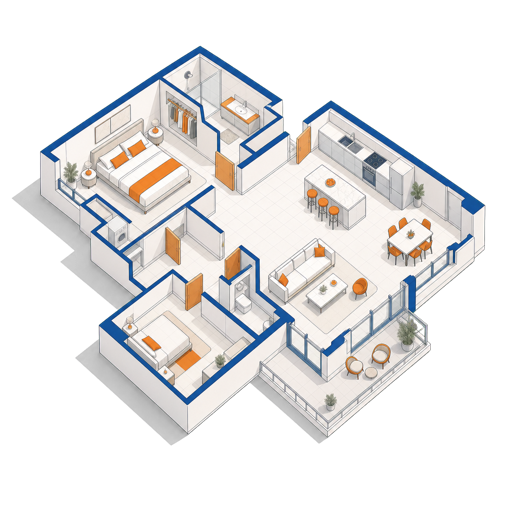
HDB Flat Types and Floor Plans: A Complete Guide
Singapore's HDB flats come in six main types — from the compact 2-Room Flexi to the sprawling Executive — each with its own floor-plan logic, room count, and renovation implications. Knowing your flat type before you renovate saves time, avoids permit surprises, and helps you make accurate spatial plans.
Why flat type matters for renovation
The flat type determines more than just how many rooms you have. It shapes the structural wall layout (which walls you can and cannot touch), the location of the household shelter (bomb shelter), wet-area plumbing positions, and how much flexibility you have for an open-concept rework. A 3-room resale from the 1980s has very different walls and proportions from a 3-room BTO built in the 2020s — even if both carry the same label.
Before engaging any contractor or interior designer, get your actual floor plan. It is the single most important document for accurate renovation planning.
The six main flat types
HDB classifies flats by the number of rooms, where "rooms" includes bedrooms but not the living/dining area. The table below shows commonly cited size ranges — treat these as approximate guides, not guarantees. Your unit's exact internal floor area (net lettable area) is shown on your official HDB floor plan and title deed; confirm it there.
| Flat type | Approx. size range | Bedrooms | Key layout notes | BTO / Resale? |
|---|---|---|---|---|
| 2-Room Flexi | ~35–47 m² | 1 | 1 bedroom + living/kitchen/bath. Two lease options (99-yr or short lease for seniors). Open layout in newer units. | BTO & resale |
| 3-Room | ~60–75 m² | 2 | 2 bedrooms. Older stock can have generous room sizes; newer BTOs are more compact but efficient. | BTO & resale |
| 4-Room | ~85–105 m² | 3 | 3 bedrooms. The most common HDB type. Older resale units may have enclosed kitchens and separate living/dining alcoves; newer BTOs tend toward open-plan. | BTO & resale |
| 5-Room | ~107–130 m² | 3 | 3 bedrooms, but a larger living/dining area than a 4-room. Some older units include a utility room or yard space. | BTO & resale |
| 3-Gen (Multi-Generation) | ~115–125 m² | 4 | Designed for 3-generation living. Extra master bedroom suite with its own bathroom. Eligibility rules apply — check HDB's current conditions. | BTO only |
| Executive (EA / EM) | ~130–150 m² | 3–4 | Resale-only (no longer built new). Executive Apartments (EA) are single-storey with a study/4th room. Executive Maisonettes (EM) are rare two-storey units. Both built mainly in the 1980s–1990s. | Resale only |
The "number of rooms" naming can mislead: a 4-room flat has 3 bedrooms, and a 5-room flat also has 3 bedrooms (just a larger living area). The extra "room" in the name refers to the combined living/dining space counted separately in older HDB terminology.
BTO vs resale: the floor-plan difference that matters
Built-to-Order (BTO) flats are newly constructed units you apply for from HDB before they are built. Resale flats are existing units bought on the open market — they may be anywhere from a few years to over 40 years old.
From a floor-plan and renovation standpoint, the differences are significant:
- Layout generation: Older resale flats (built in the 1970s–1990s) often have enclosed kitchens, smaller bathrooms, separate utility rooms, and sometimes larger individual bedrooms. Newer BTOs lean toward open-plan living/dining, smaller but better-proportioned rooms, and prefabricated bathroom components.
- Wall types: Older flats used more in-situ reinforced-concrete walls. Newer BTOs use a mix of RC structural walls and lightweight block/drywall partitions. This affects what can be hacked — always check with HDB and a licensed contractor before assuming a wall is non-structural. See our guide on hacking and partition walls for details.
- Wet-works rules: Flats less than about 3 years old (from TOP date) are subject to stricter restrictions on wet works such as retiling and hacking of floor screeds. This applies to new BTO flats you just received keys for. Confirm current rules with HDB and your licensed contractor.
- Size variation: A resale 4-room can range widely in actual floor area depending on when and where it was built. Do not assume the type name tells you the sqm — read your floor plan.
When comparing a BTO and a resale flat of the same type, look at the actual floor plan dimensions — not just the sqm number. Room shape (square vs narrow) can matter more than total area for furniture layout and renovation cost.
How to read an HDB floor plan
An HDB floor plan shows the unit boundary, room layout, and key structural elements. Here is what to look for:
- Walls: Thick solid lines (usually RC/concrete) are structural and cannot be hacked. Thinner lines or hatched fills may be non-structural lightweight walls — but verify; never assume.
- Household shelter (HS): The bomb shelter, typically near the entrance or service area, has reinforced concrete walls on all sides and must not be modified. Its location is always marked on the official plan.
- Wet areas: The kitchen, bathrooms, and utility/yard areas. Plumbing riser positions (shown as circles or squares on the plan) cannot be moved; your fixtures must connect to these fixed points.
- Door and window openings: Shown as arcs (doors) and thin parallel lines (windows). Opening positions in structural walls are fixed; non-structural partitions can sometimes have openings added or removed with the appropriate permit.
- Dimensions: Official plans show wall-to-wall internal dimensions. Use these — not the sqm total — when planning furniture and cabinetry. A sofa, bed, or kitchen island needs to fit the actual room width, not the nominal flat size.
Where to get your official HDB floor plan
There is one authoritative source: HDB's official e-Services portal. Here is how to access it:
- My HDB Page (MyHDBPage): Log in at the HDB website using your SingPass. Under "My Flat," look for the floor plan section — you can view and download your unit's official floor plan as a PDF. This is the most direct route for current owners.
- HDB e-Services portal: The HDB website (hdb.gov.sg/eservices/) provides a range of services including the ability to request or purchase a floor plan for your unit. Some floor plans are available for free download; others may carry a small administrative fee — confirm at the time of access.
- OneMap: Singapore's national map platform (onemap.gov.sg) is developed by the Singapore Land Authority and integrates HDB block data. You can search by block/street and view typical floor-plan layouts for many blocks — useful for research, though it shows typical plans for the block type, not necessarily your unit's as-built state.
- BTO brochures: If you are buying a new BTO flat, HDB publishes detailed floor plans in the sales launch brochure. These are downloadable from the HDB Flat Portal during the sales exercise.
Third-party property portals and renovation company websites may show indicative or generic floor plans for your flat type. These are useful for orientation but are NOT your unit's actual plan. Always obtain the official plan from HDB before starting renovation work — dimensions can vary even within the same block.
Block, unit, and storey: understanding HDB addressing
An HDB address has three levels of specificity that affect your renovation planning:
- Block: The building number (e.g. Block 123). A single block may contain multiple flat types across different stacks. Not every unit in the same block has the same layout.
- Stack / unit number: Units in different stacks (e.g. #01-01, #01-45) face different directions and may have mirror-image layouts or different corner configurations. Corner units often have extra windows but also more external walls — relevant for thermal comfort, aircon placement, and window-facing sun.
- Storey: The floor level affects natural ventilation, noise (from ground-level amenities or overhead), structural loading, and sometimes lease value. For renovation, high-floor units may have slightly different ceiling heights in older blocks.
When you plan your renovation, always reference your specific stack and unit number — not just the flat type or block number — when reviewing floor plans or discussing layouts with contractors.
Planning your renovation from the floor plan
A scaled floor plan is the foundation of any renovation. With your actual room dimensions in hand, you can:
- Determine whether an open-concept kitchen is feasible (and which walls are structural).
- Plan furniture layout at true scale, avoiding costly mistakes like a bed that blocks a door swing.
- Mark out where aircon piping, electrical points, and data cabling need to run — before walls are closed up.
- Identify the household shelter position so you can design around it rather than into it.
- Share an accurate plan with your interior designer or contractor for quoting — vague sketches produce vague quotes.
If you want to move beyond a static PDF, you can upload your HDB floor plan to StoreySG and rebuild it at true millimetre scale in your browser — no installation required. You can then use natural-language commands to place furniture, swap finishes, and try different layouts before committing to any physical work. The tool also lets you export a CAD-ready DXF of your plan, which your contractor or interior designer can open in AutoCAD or a similar program. Read more in our guide on precise CAD floor plans.
Before any renovation begins, check whether your planned works require an HDB renovation permit. Our HDB renovation permit guide covers what needs approval, how to engage a licensed contractor, and the rules around permitted renovation hours.
Design it in StoreySG
Upload your floor plan and design right in the browser — no install, no gaming PC. Edit by natural language, keep 2D and 3D in sync at true millimetre scale, and export a CAD-ready DXF, render-ready 3D, or a furniture list.
Try the editor freeFrequently asked questions
How many bedrooms does a 4-room HDB flat have?
A 4-room HDB flat has 3 bedrooms. The naming counts the living/dining area as an extra 'room' — a convention that dates back to older HDB terminology. A 5-room flat also has 3 bedrooms, but with a larger living/dining space.
Where can I get my HDB floor plan?
Log in to the HDB website using your SingPass and go to My HDB Page — under 'My Flat' you can view and download your unit's official floor plan as a PDF. Alternatively, use the HDB e-Services portal (hdb.gov.sg/eservices/) or the OneMap platform for typical block-type plans.
What is the difference between a BTO and a resale HDB flat in terms of floor plan?
BTO flats are newly built with modern layouts that tend toward open-plan living/dining areas and standardised fittings. Resale flats vary widely by decade of construction — older units often have enclosed kitchens, separate utility rooms, and sometimes larger individual bedrooms, but also older plumbing positions and more in-situ concrete walls.
What is a household shelter (bomb shelter) and can it be renovated?
The household shelter (HS) is a reinforced-concrete room — typically near the main entrance or service area — that must not be modified or structurally altered. You can use it for storage and fit it with shelving, but the reinforced walls, door, and ventilation block cannot be hacked or removed.
Are Executive HDB flats still being built?
No. HDB Executive Apartments (EA) and Executive Maisonettes (EM) are no longer built new — they are available only on the resale market. Most were constructed in the 1980s and 1990s. Executive Apartments are single-storey with a study/fourth room; Executive Maisonettes are rare two-storey units.
Can I renovate a flat less than 3 years old?
Newly received BTO flats (within roughly 3 years of TOP date) face stricter restrictions on wet works such as retiling floors and hacking screeds. The exact rules can change — confirm current requirements with HDB and your licensed contractor before planning any work.